Sunday, October 07, 2012

He always carries a copy of the laws of Vietnam, and the Bible in his heart

Ma was a deputy to the chief of police and a Vietnamese communist party member.

In 1996, his nephew showed him a New Testament. When Ma's entire family got sick, he remembered what he had read about Jesus healing people. Twelve members of Ma's family had died of illness, so Ma asked a pastor to pray for a young nephew. Ma' s nephew was healed, and Ma gave his life to the Lord!

But a year later, he lost his job when the party learned of his conversion.

So he returned to his village and began to tell others about God. Although he had no training - he knew only what he had read in the Gospels and what the pastor had told him - 100 people came to
Christ
in the first year of his ministry.

In 1998 he was arrested.

"They kept me for three days and beat me because they knew me from when I belonged to the
communist party," he said. Ma used the time to share the gospel with his former comrades, and six of the party members became believers. He was released.

Ma, now 62 years old, at this point oversees nine house churches and nearly 1,800 believers. Christians face many restrictions in the region where Ma works. They are not allowed to gather in groups of more than 20, and, unlike other villagers, Christians are not provided houses by the government. In addition, Bibles are not allowed, so Christians must hide their Bibles and read them only after dark.

Ma leaves his Bible behind when he travels to preach, afraid that it would be confiscated if discovered. Instead, he writes his sermon on paper and hides the Scripture in his heart.

He always carries a copy of the laws of Vietnam so that when he is questioned he can confront the police with their own laws. Despite government harassment and restrictions, Ma has learned how to continue his ministry and continue sharing the hope of Jesus Christ.

(from Voice of the Martyrs newsletter, August 2012)

(To receive new uMarko posts via a daily email, please click Subscribe)

Tuesday, October 02, 2012

Birds, Insects, and Bats Fly by Design, not by Accident!

Evolutionary philosophy tells us that "we can now safely say (!) that the illusion of design in living creatures is just that — an illusion.” But as any engineer or inventor can tell you, the mind staggers at the amount of planning which would be needed to accomplish this outrageous, systematic “appearance of design.”  The amazing and completely different ways that birds, insects, and bats are able to fly is a case in point, the workmanship of a majestic Creator!

(Selections from Gary Howell, "Naturalistic Evolution: a Dangerous Humanistic Philosophy" published in Creation Matters, a publication of Creation Research Society, Volume 17, Number 4, July/August 2012, to appear at http://www.creationresearch.org/creation_matters/pdf/2012/CM17%2004%20for%20web.pdf)

The grand difficulty revealed with the study of nature is that ineffable, pesky, enigmatic, and inviolable appearance of design; it just won't go away! Worse yet, the more layers that are peeled away, the more design is confirmed.

Speaking as an engineer with 17 domestic and international patents, I maintain that the proposition of complex systematic designs emerging devoid of preparation, concepts, planning, technological building blocks, and thinking is scientifically untenable and insulting. No matter how complex the design interaction, with design interdependency built upon design interdependency, evolutionary philosophy simply insists these only “appear designed.”1

Leonardo da Vinci’s plans for an ornithopter,
a flying machine kept aloft by
the beating of its wings; about 1490.
Another assertion of naturalistic evolution is that multiple solutions to the same problem evolved independently. Take flying for example. Leonardo da Vinci dreamt of it and advanced unsuccessful designs, including the ornithopter.2 It was not until we began to get the drift of differential pressure as a result of airfoil (Bernoulli's principle) did anything near a successful flying machine emerge. But the animal kingdom "solved" this system-intensive problem three different ways: birds, insects, and mammals.

Bird Flight

Birds fly by means of multiple technologies, but principally via a feature called feathers. Feathers are manufactured in hair-follicle variants consisting largely of finger-naillike material, β­-keratin.3
There are numerous feather variants that can be described within six general categories: tail, flight, semiplume, filoplume, bristle, and downy.4  Of these, downy or down is the simplest, having no barbs and barbules, or “hooks” latching adjacent filaments.  Being the “simplest feather” nonetheless, no manmade material to date approaches down’s thermal, weight, and rebound characteristics.

“Light as a feather” is more than a cliché as an engineering design team ponders equaling the feather’s specifications: strength-to-weight ratio, modulus of elasticity, ductility, hollow-tapered-cantilevered central-support beam — and let us not underestimate the incidental design detail — it must grow in place!


Bird wing is a true airfoil
Feathers must be sized and placed quite accurately, and hooked together, creating a contiguous outer surface. Bird-wing architecture is a true airfoil. Its arched geometry causes air passing over the top to travel at a greater velocity than air passing below the wing. This causes negative pressure above the wing which lifts the bird.  It’s fascinating for birds (that are, we’re told, dinosaur derivatives) to have solved this systematic, technological difficulty without intent or intelligence!

It is exactly the means of lift utilized by 747’s and F-15’s. But bird wings are much more complex than modern aircraft wings, because they are variable airfoils! With anticipatory, neural-feedback networks, bird wings adjust to situational events involving propulsion, ascent/descent, air speed, cross winds, air density, proximity, and the like. Modern aeronautical engineers can only dream of variable airfoils, as da Vinci dreamed of flying.

Insect flight

Naturalistic evolutionary philosophy alleges that insects evolved from different origins than did birds, but insects nevertheless "solved" the difficulties of flight with quite unusual features. Not with feathers but with chitin, a naturally-occurring, structural polymer called a polysaccharide.

Insect flight employs some elements of airfoil design, but insect propulsion and lift are largely credited to vortices which are created at the leading edge of the insect wing, and to the flapping motion that causes the vortices to spiral out to the wing tip.5 It is certain that man-made flight abhors vortices (turbulent air flow versus laminar air flow), but insect flight deliberately induces powerful vortices, and uses them effectively for lift, propulsion, and maneuverability!

Schematic reconstruction of wake pattern during wake–wing interaction in fruit fly and dragonfly model wings

Bird lift and propulsion are limited to the downward stroke, but insects are capable of rotating their wings fully backward so that the wing’s upper surface creates lift in the upward stroke also — i.e., every stroke provides lift and propulsion. They can fly upside down, as in landing on a ceiling, or backwards and sideways. The mind staggers at the number of prototypical iterations which would be needed to accomplish this outrageous, systematic “appearance of design.”  Entomologists and aeronautical engineers are just beginning to understand and appreciate the extreme airborne capability of these diminutive creatures.

Mammalian flight

Bat wing anatomy
Bats are mammals — live birth, warm bodies, milk-fed young — and quite different from bugs and birds, but they are creatures that once again solved the flying enigma by altogether different design stratagem and materials selection. Bats, after all, “simply” stretch a skin membrane over a bony structure and take to the air. But it’s hardly that simple, as the skin/bony structure must make up the aforementioned airfoil, with the neuro-muscular systems in place to vary wing geometry and, thus, to sustain intrepid, long-distance flight and crazy acrobatics.

Oh, and dare we mention the incidental, fully integrated, co-developmental echo-location feature! No big deal, according to our best collegial biology professors, but these cavalier academics never designed and developed anything themselves! It is scientifically antithetical and a hopelessly vacuous proposition (let alone a factual imperative) to suggest the mechanisms purported by naturalistic philosophy could produce any of these flying machines, and especially to do so by three distinctly differing methodologies.

Final thoughts

The evolutionary empire has grown so vast and powerful that no other viewpoint is tolerated at any venue. This is especially true in agencies associated with government. No competing view is permitted at schools or work places with government tentacles. Those who dare are ridiculed at best, but most often spurned, dismissed, and persecuted. No written, oral, private, or public dissention is tolerated.

Scriptural premise, especially Christianity, as a competing religion to that of naturalistic evolution, will not be tolerated.

(To receive new uMarko posts via a daily email, please click Subscribe)

References (selected)

1.  Dawkins, R. 2006. The God Delusion. Houghton Mifflin Company, Boston, MA.  [See p.. 139, “We live on a planet where we are surrounded by perhaps ten million species, each one of which independently displays a powerful illusion of apparent design.”; and p. 158, “Darwin and his successors have shown how living creatures, with their spectacular statistical improbability and appearance of design, have evolved by slow, gradual degrees from simple beginnings. We can now safely say that the illusion of design in living creatures is just that — an illusion.”

2. Fuller, J. 2012. Top 10 bungled attempts at one-person flight: 9. Leonardo da Vinci's Complex Ornithopter (c. 1505). HowStuffWorks. Retrieved August 11, 2012, from http://science.howstuffworks.com/transport/flight/classic/ten-bungled-flight-attempt2.htm.

3. Anonymous. 2012. Feather. Wikipedia.  Retrieved August 11, 2012, from http://en.wikipedia.org/wiki/Feather.

4. Kazilek, C.J. 2012. Feather biology. Ask A Biologist, Arizona State University.  Retrieved August 11, 2012, from http://askabiologist.asu.edu/explore/feather-biology.

5. Anonymous, 2004. Animal Flight Group: Aerodynamics. Department of Zoology, University of Cambridge.  Retrieved August 11, 2012, from www.zoo.cam.ac.uk/zoostaff/ellington/aerodynamics.html.

Thursday, September 27, 2012

The Church on the Camel's Path

Two men named Ahmed and Mechela were driving through the African desert, on their way to visit some Christ followers in a distant region.

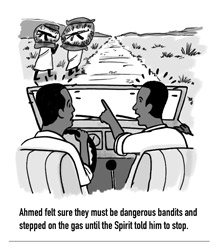
As they bumped along the rutted dirt track, they came upon two elderly men walking with large burdens wrapped in blankets on their shoulders. But Ahmed didn’t slow down; in fact, he stepped on the accelerator, hard. It was not uncommon to be waylaid by criminals brandishing AK-47s, and Ahmed was in no mood to take any chances.

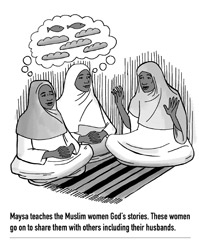
They were about two hundred kilometers from a region where a special person named Maysa lived. She was a was a very ordinary person, traveling with her husband and livestock around the the countryside with groups of other nomads looking for grazing areas for the animals. The couple were both Christians, alone in an area where everyone else was Muslim. Maysa had attended a training seminar offered by a missions organization, in which she learned how to tell stories from the Bible, beginning at creation and moving forward chronologically toward Christ. As soon as she rejoined her family, Maysa began sharing these stories with other nomadic women. That was just one year ago.

As soon as Ahmed and Mechela roared past the elderly men in a cloud of dust, the Holy Spirit pressed Ahmed as hard as he had pressed the gas pedal. Ahmed felt instantly convicted that he had made a poor choice, and he found himself easing off the gas and stepping on the brake.

The elderly men clambered into the backseat, bowing and grinning to the Christians in the front as they dumped their burdens, from which no firearms appeared, onto the floor. Mechela breathed a sigh of relief.

Soon they were chatting together. Mechela asked,  “Would you like to hear a story?” he asked. There were no radio stations in the desert, and storytelling was a good way to pass the time, so the men readily agreed, “Well” continued Mechela, getting comfortable in his reversed position on the front seat, ‘do you know where the whole world came from? It was like this: in the beginning… .” He had not gotten more than a minute into his story when he was abruptly interrupted. “Oh, we already know that story!” cried the hitchhikers in unison.

Poor Mechela was taken aback once again. He stared at his new friends with open mouth, too surprised to speak, so Ahmed rescued him by asking the men to tell their own story of creation. And they proceeded to recite it verbatim according to the way his missions team taught the Scriptures to those who could not read. As the men began to tell Mechela and Ahnied the story of Noah, Ahmed asked them, “Excuse me, but where did you learn these stories?

“Last rainy season,” the men answered, “a man moved to our village and taught us these stories and many others. Let us tell you about the great Flood... and we have many other stories that we would like to tell you.”

It took the remainder of the trip, but Ahmed and Mechela eventually were able to piece things together. They traced the source of the Bible stories that the men had learned all the way back to Maysa and her husband, who had led others to become disciples of Christ, who in turn had gone to distant villages and shared the gospel with more nomads. These two elderly men, hitchhiking their way through the desert, were the fifth generation of Christ followers growing out of Maysa’s efforts, and they were on their way to share the gospel with a young couple who would soon be married and would carry it on to others. And all this took place in the space of one year!

This spreading of the gospel through the desert, one person sharing Scripture stories with another outside of any formal setting, is what Ahmed and his team call “the church on the camel’s path.

(excerpted from Jerry Trousdale, Simple Churches: Dramatic Transformations, Rapid Replication, Mission Frontiers, Sep/Oct 2012)

(To receive new uMarko posts via a daily email, please click Subscribe)

Tuesday, September 18, 2012

His toughest years were when there was no Bible

He was locked in a cell by himself for a year, without a Bible. Bounchan asked the guard who brought his food to send a message to his wife. "Tell my wife, 'Would you please help me? Bring me a Bible. I cannot live without the Bible."' But a Bible was forbidden in Laos.

After a year in solitary confinement, Bounchan was put to work carrying firewood and clearing rice fields. Eventually, the guards trusted Bounchan enough to let him gather firewood alone. In July or August 2007, they allowed him two or three hours to gather wood because a nearby stream was flooding. "I knew the routine," he said. "On the first day, I collected enough firewood for two days. On the second day, I swam through the flooded stream, ran to my house, took five Bibles and ran back. I hid the Bibles, then carried the firewood back to the camp."

He also smuggled in small radios wrapped in large leaves when he brought back firewood. "I read my Bible every day," he said. "I also listened to a Christian program on the radio."

The Bible and radio helped him grow in faith. One day, the guards discovered his Bible and radio and confiscated them, but Bounchan simply smuggled more into his cell. During his 13 years in prison, Bounchan owned six Bibles. His toughest years were those when he didn't have a Bible.

In January 2012, the chief of the prison told him, "Your family is so strong in their faith that Christianity has spread everywhere. That is why you remain here. We will not let you out because your family still spreads the gospel. If you want to be released, go back home, drink and play and join the [communist] party like us. Don't live like you have; stop believing in your faith or you will remain poor."

Bounchan replied, "If you stop worshiping the cement idol, if you stop worshiping the gold or bronze idol, then I will stop worshiping my God. You won't stop. Why do you force me to stop?"
Bounchan was released one month later, on Feb. 2, 2012, two years before his sentence was complete. He said, "Thank you to my brothers and sisters in America, Canada and many other countries for your faithful prayer. I know that I am still alive today because of your faithful prayer. I am now sharing my testimony because of your powerful prayer."

(from Voice of the Martyrs newsletter, August 2012, also see Bounchan: Imprisoned for Christ)

(To receive new uMarko posts via a daily email, please click Subscribe)

Saturday, September 08, 2012

Deliver me, Lord! I promise to serve You if You just let me live...

David Tseda joined a militia group as a young adult after 21 of his family members were killed in the Congo war. He proved to be an effective fighter and commander, but one day found himself in a hopeless situation, expecting to be killed. “Deliver me, Lord!” he pleaded. “I promise to serve You if You just let me live.”

And God did deliver him! David escaped from his captors, but ... he continued to live the same violent life.

A few years of fighting and more death all around him went by. One day his group captured a woman, who did not ask them for mercy the way they all do. Instead, she kneeled a few feet away from him, and prayed out loud. “Deliver me, Lord!” she pleaded. “I promise to serve You if You just let me live.”

David stopped dead in his tracks. Though the noise around him only grew louder as his militia group barked orders to the kneeling woman and their other prisoners, David heard nothing — just her words pounding over and over in his head. He, too, had prayed that very same prayer a few years before. He recalled his promise to God. I never kept my end of the bargain, he suddenly realized. It’s time to make it right.

David became the first demobilized fighter in the region in 2004 when he left the militia to study the Bible at Shalom University. Walking onto campus in his fatigues that first day, he had no idea what he would do or how God might use him — all he knew was that he had a promise to keep.

Now, eight years later, David serves as the pastor of a local church and has returned to Shalom to earn a master’s degree in theology. David said, “I want to help demobilized soldiers just like me experience the forgiveness and purpose of life that I have found in Christ.”

(adapted from Surprising Outcome in Congo, Crossworld, August 11, 2012)

From Crossworld: Most Congolese Christians lost their Bibles in the Congo war. They long to purchase new ones, but the current cost for one Bible is equivalent to $1,000 — an impossible price for people who make less than that in a year. Give to the Congo Bible Project #91025 and help offer Bibles at a dramatically reduced cost.

(To receive new uMarko posts via a daily email, please click Subscribe)